


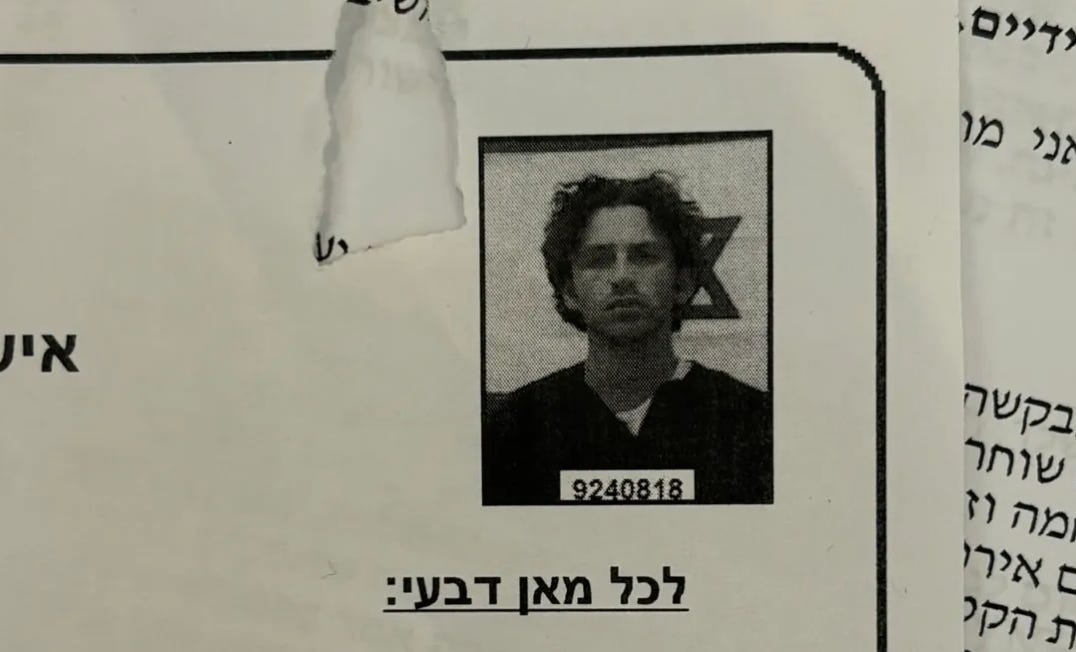
“Subject is being detained in the Russian Compound in Jerusalem.”
- Email from an Interpol contact to U.S. State Department officials, October 9, 2024
Shortly after October 7, 2023, I began taking regular reporting trips to Israel and Palestine. Taking advantage of my U.S. passport, I passed through security at Ben Gurion Airport with ease and, on other trips, crossed from Jordan into the occupied West Bank with no difficulties.
On these reporting trips, I documented and investigated the surge in military-backed settler violence that happened in the immediate wake of October 7th, resulting in the total ethnic cleansing of more than 40 Palestinian villages in just a couple of months.
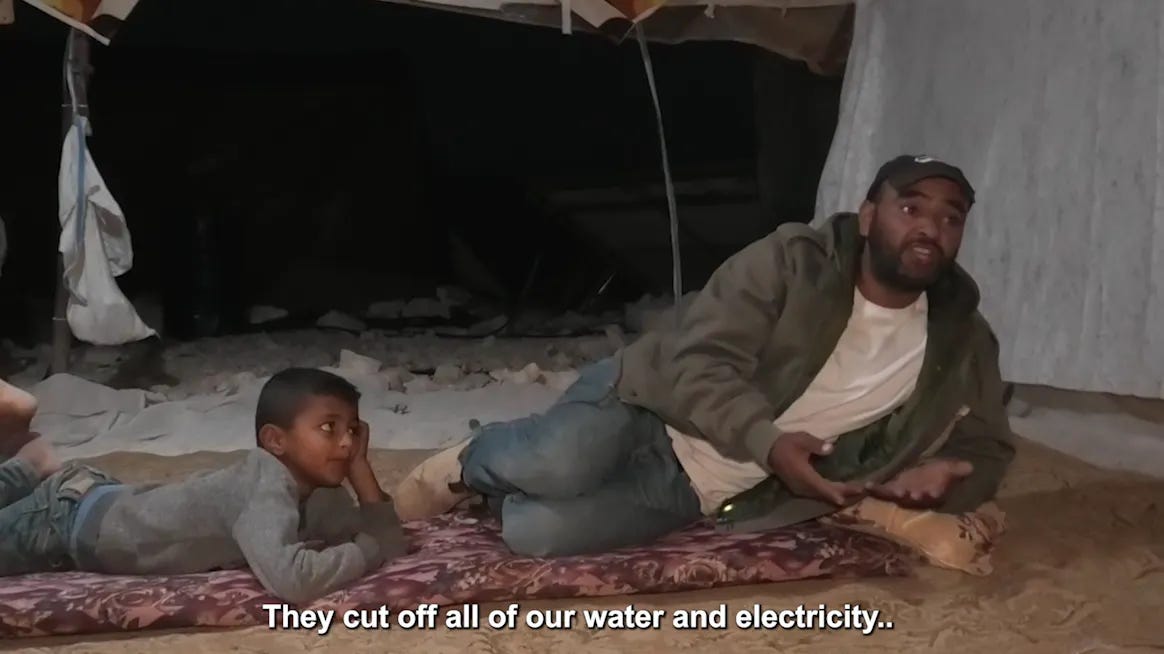
My reporting also took me to the very south of Israel, where I covertly embedded with fanatic Israeli nationalists at the Karem Shalom and Nitzana border crossings to document their collaboration with the IDF to block desperately needed humanitarian aid to the besieged Gaza Strip.
On another occasion, I followed Israeli settlers past the Erez crossing into Gaza as they called for the Jewish resettlement. “We already have it all planned out. All of the neighborhoods and all of the yeshivas,” one of the Staten Island-born Israeli settlers told me as she marched into Gaza.
On October 8, 2024, while navigating winding, mountainous apartheid roads reserved for Palestinians along with several other journalists, on my way to report on the ongoing Israeli military siege of Jenin refugee camp, we reached one of the dozens of military checkpoints along the route. There, we were told by the IDF to stop the car and hand over our IDs. After handing over my passport, we were all instructed to get out of the car and sit on the ground.
I was then blindfolded, handcuffed, shackled, put into a humvee, brought to a remote West Bank Israeli police compound, and then eventually to Jerusalem’s Moscobiyeh prison.
Moscobiyeh is sometimes referred to as “the slaughterhouse” due to the brutal torture techniques employed by Israel’s internal security services. According to Addameer, a prisoner support NGO based in Ramallah: “mistreatment in Mascobiyeh is not only witnessed in the interrogation rooms, but rather is an integrated system operating to terrorize and break the detainees’ spirit.”
What followed the initial arrest and transport was an ordeal lasting nearly four days, during which I was held in solitary confinement, led around in shackles, and interrogated for hours in the middle of the night. Israeli authorities officially “suspected” me of “aiding the enemy during wartime,” a crime carrying a potential sentence of life imprisonment or execution.
Basis for the suspicion was a video report I had published just days earlier documenting the impact sites of Iran’s Operation True Promise 2, the October 1, 2024, ballistic missile attack launched in retaliation for Israel’s assassinations of Hezbollah leader Hassan Nasrallah and IRGC commander Abbas Nilforoushan. In the report, I interviewed Palestinians in the Negev desert who had no access to bomb shelters provided by the Israeli state and were forced to take cover beneath highway overpasses and in sewers. I also located a missile impact site in Tel Aviv, not far from Mossad headquarters.
And what followed my detention was another 11-day ordeal outside the literal prison, but still inside the big prison that is Israel. A judge had agreed to release me on the condition that Israeli security services could continue interrogating me and retain my passport, phone and laptop, a deal the Shabak themselves objected to. I was summoned to a remote West Bank military compound for interrogations lasting up to seven hours, without a translator. Officers would leave the interrogation room and return moments later, yelling at me and demanding answers like a police procedural TV drama. Throughout this period, I faced the constant threat of being sent back to prison, while Israeli military police held onto my phone and laptop to search through my files and communications.
During these chaotic 15 days total of arbitrary orders, interrogations, and imprisonment over a video report I had published as a credentialed member of the press, I felt as if my government, the United States, had forgotten about me. But they hadn’t. They were paying very close attention to my situation, not to help me, as a U.S. citizen who was being subjected to arguably torturous conditions and tried for espionage crimes for practicing journalism, but merely for PR reasons, as a folder of 140 pages of partially redacted U.S. State Department emails obtained through a FOIA request now shows.
The first email the State Department received about my arrest did not come from U.S. officials stationed in Israel, but from an Interpol contact in Jerusalem. The contact informed the department that I had been arrested by the IDF’s Central Unit of the Judea and Samaria District on suspicion of “aiding a hostile entity in war” and “providing security information to a hostile entity.”
“Subject is detained in the Russian Compound detention center in Jerusalem,” the October 9th Interpol email reads.
As the emails reveal, over the next 24 hours, while I was being held in Moscobiyeh prison and news of my arrest spread across American social media and Israeli news outlets, officials in Washington were scrambling, frantically exchanging emails – not to secure my release – but to formulate talking points around the incident. Search results for “TP,” the State Department acronym for talking points, yield 62 results in the FOIA’d documents.
“The 7th Floor (senior State Department officials) and the White House are tracking this story closely,” an email from the first days of my incarceration reads.
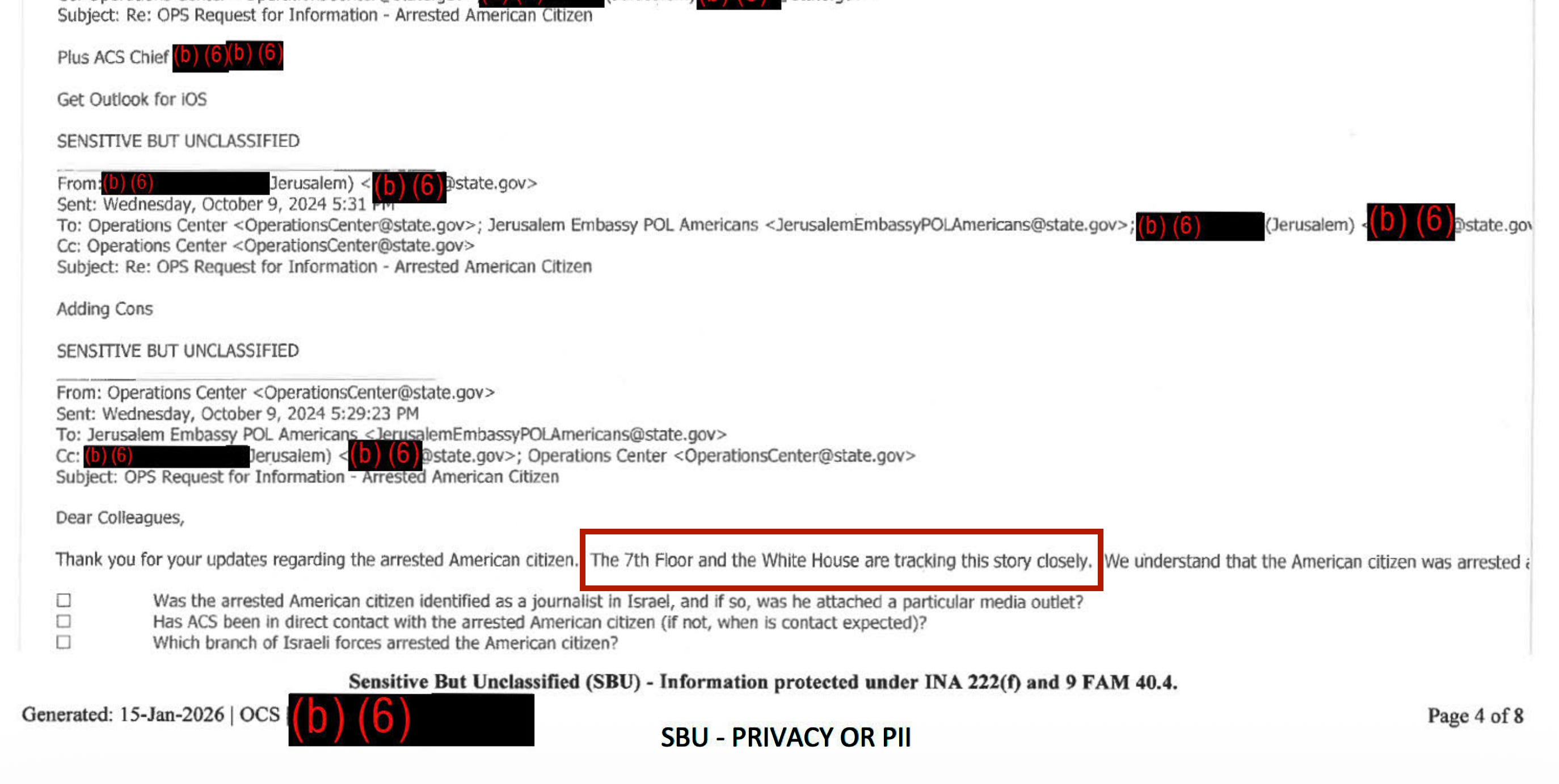
Despite interest from the highest levels of the U.S. government, the emails contain no discussion of whether or not the charges against me were valid or bogus, the extreme conditions of my incarceration, or any talk of pressuring or using diplomatic leverage in order to expedite my release, even as dozens of Americans began calling the State Department to demand information and action.
According to the emails, the department received 73 calls about my situation over two days, 33 on October 10 and 40 on October 11. One employee asked their superior, “Do we have a script in order to provide callers?”
A State Department supervisor forwarded the email to a higher-ranking official, writing: “We are receiving a few calls about Jeremy Loffredo, the journalist who was taken hostage/kidnapped in Israel…”
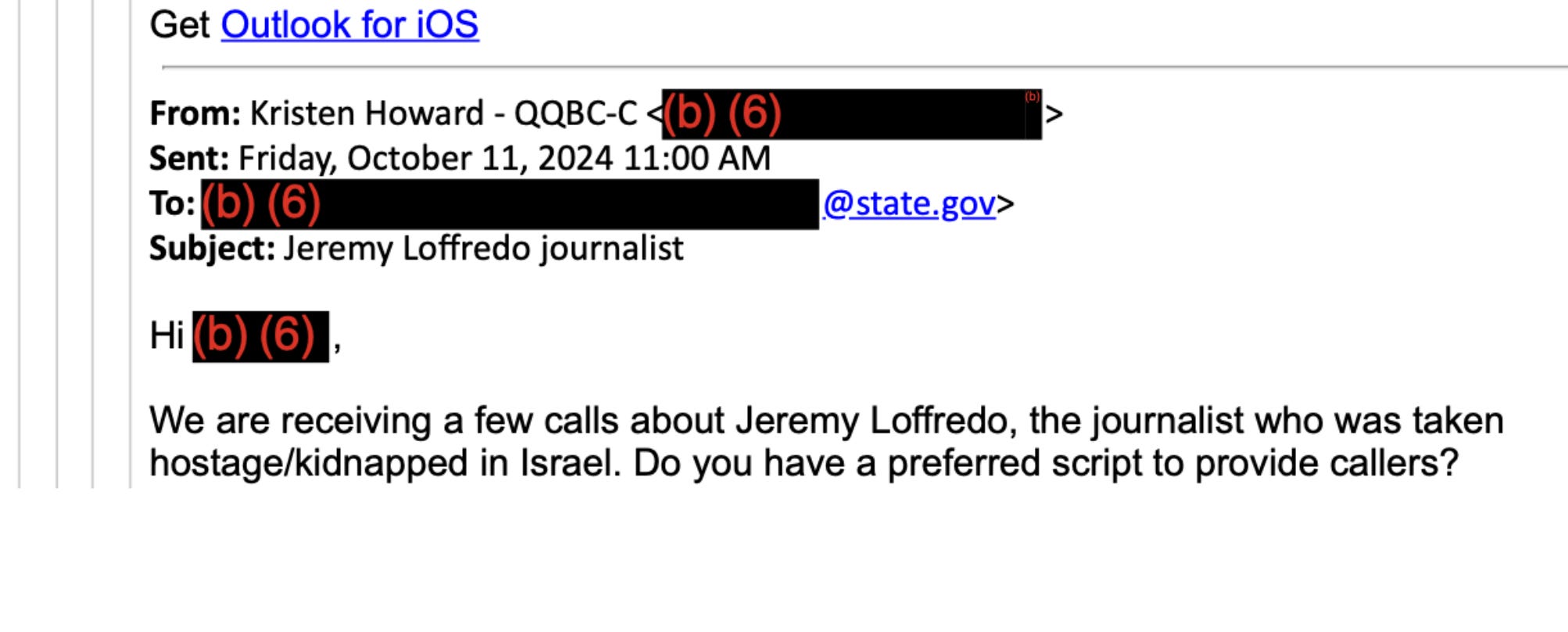
Yet even as State Department employees described my detention as a kidnapping by the IDF, the internal correspondence focused solely on managing communications and limiting potential damage to the Biden administration’s public image.
In an October 9 email, a State Department official acknowledged that the “aiding the enemy” allegations against me represented a “marked increase in severity” compared with the accusations Israel typically brings against journalists. Despite recognizing the seriousness of the allegations, U.S. officials neither pursued any diplomatic intervention behind the scenes nor publicly challenged Israel’s actions.
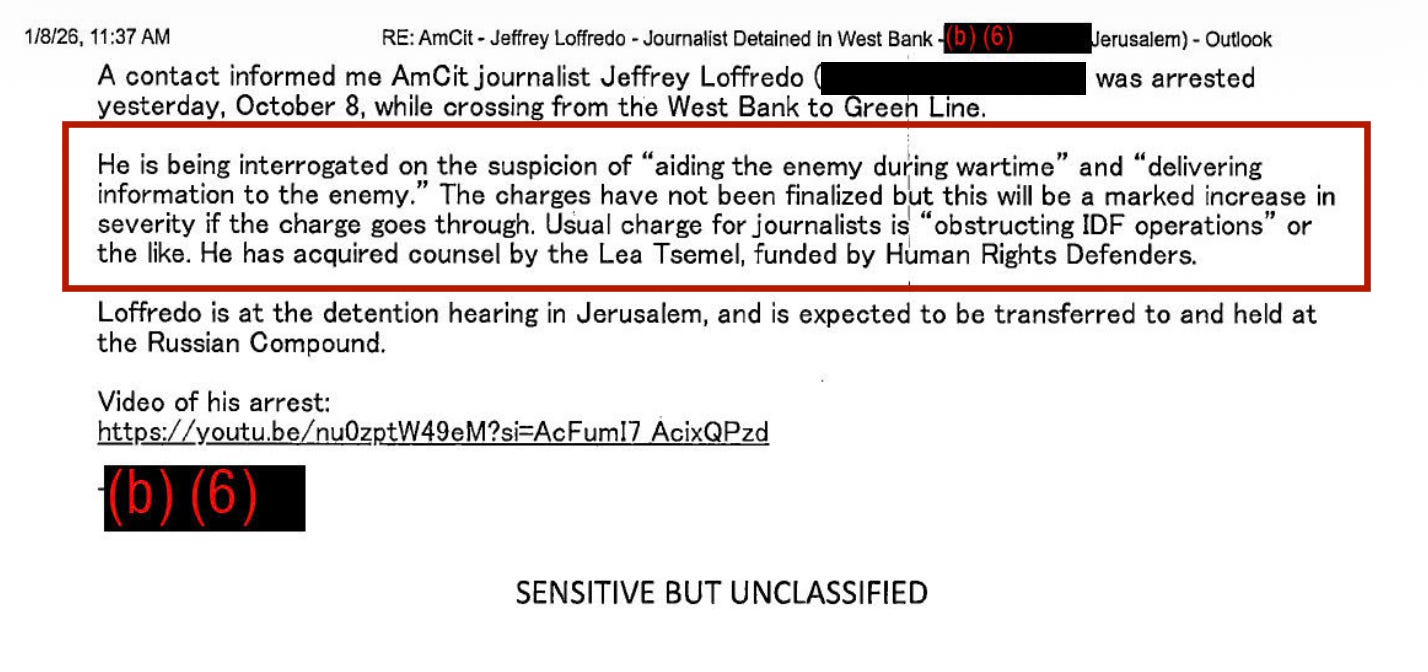
Officials were instructed to give the standard line that “the United States condemned threats and violence against journalists and that no members of the press should be intimidated, threatened or attacked” whenever they were asked for official comment by reporters or press freedom organizations.
State Department officials were informed that the Israeli security services had interrogated me at a remote hilltop West Bank security compound near the settlement of Ma’ale Adumim for seven hours on October 14, from 10 a.m. to 5 p.m., without offering food, water, or breaks.

On October 17, Epoch Times reporter Ryan Morgan asked whether the U.S. government had designated me a “wrongfully detained U.S. citizen,” a formal designation it had applied in similar cases involving Americans detained abroad, including Wall Street Journal reporter Evan Gershkovich.
The reporter explicitly rejected a generic statement about the U.S. government’s opposition to threats and violence against journalists, as well as any response about whether Washington would “welcome” my release, pressing instead for a direct answer on whether I had received the wrongful-detention designation.
Despite referring to me as “kidnapped” and knowing that I faced allegations carrying a minimum life sentence, which had already been reported in outlets such as The Intercept, where my lawyer discussed my potential sentence, the State Department employee was advised by a superior not to answer the reporter’s question directly and instructed to rely on approved talking points. “I would not address wrongful detention and instead pivot,” the email reads.
Among the files released to me is a heavily redacted Bureau of Consular Affairs “activity log,” a chronological record of actions taken in an American citizen’s overseas consular case. The activity log shows the U.S. government was meticulously tracking my movements and case, down to the hours and minutes after my hearing to see whether Israeli security services would appeal the judge’s decision to release me. (Side note: Israeli security services appealed the judge’s release decision after the official appeal window had closed, which led to me being manhandled and pushed back into my prison cell while I was in the middle of signing my release papers, and taken to the West Bank for four hours of interrogation in the middle of the night. This fact did not make it into the official activity log.)

In an October 15 entry, a consular official summarized the situation surrounding the terrorism-related charges against a journalist, noting that Israeli security services had “climbed high on the tree” with their allegations of “courting the enemy” and were now unsure how to address their original accusations.
After 10 days out of prison but still unable to leave Israel, I remained subject to hours of interrogation whenever the authorities demanded it. When I wasn’t being interrogated, I walked around East Jerusalem, where Palestinian residents were less likely to have seen news reports identifying me as someone accused of helping the enemy during wartime.
Eventually, my lawyer called to tell me that my passport, phone, and laptop were ready to be retrieved from an Israeli military compound in the West Bank. I gave the two friends I was staying with power of attorney to collect my belongings, wary that the authorities might try something if I showed up alone as someone they had treated as a suspected terrorist. Later that afternoon, I received a photo of my successfully retrieved passport, phone, and laptop.
The following day, I successfully departed Israel through Ben Gurion Airport, where airport police questioned me but ultimately allowed me to leave. The State Department was informed of my departure almost immediately as the flight took off. Just two hours after I left Israel, the department made its very first official public comment on the entire ordeal. During a State Department press briefing, a reporter asked for an update on my situation. Spokesperson Vedant Patel responded: “My understanding is that Mr. Loffredo has left Israel.”
After my release, email threads continued in which State Department officials discussed how to respond to inquiries from certain journalists and press organizations. In an October 22 email, one State Department official wrote to another, “horray!” explaining that they had “been super busy with this one” and could finally “close this one up.”

More not normal insanity from the uniparty smh.
Glad you got out safely.
I truly despised Biden and his administration. Useless.